• GET Mollie Engelhart's New Book •
Order Today!

Unlock the full course for just $47
The Essential Cycles of Regenerative Agriculture
A science-based webinar series exploring the natural processes that underpin regenerative agriculture and long-term farm resilience.
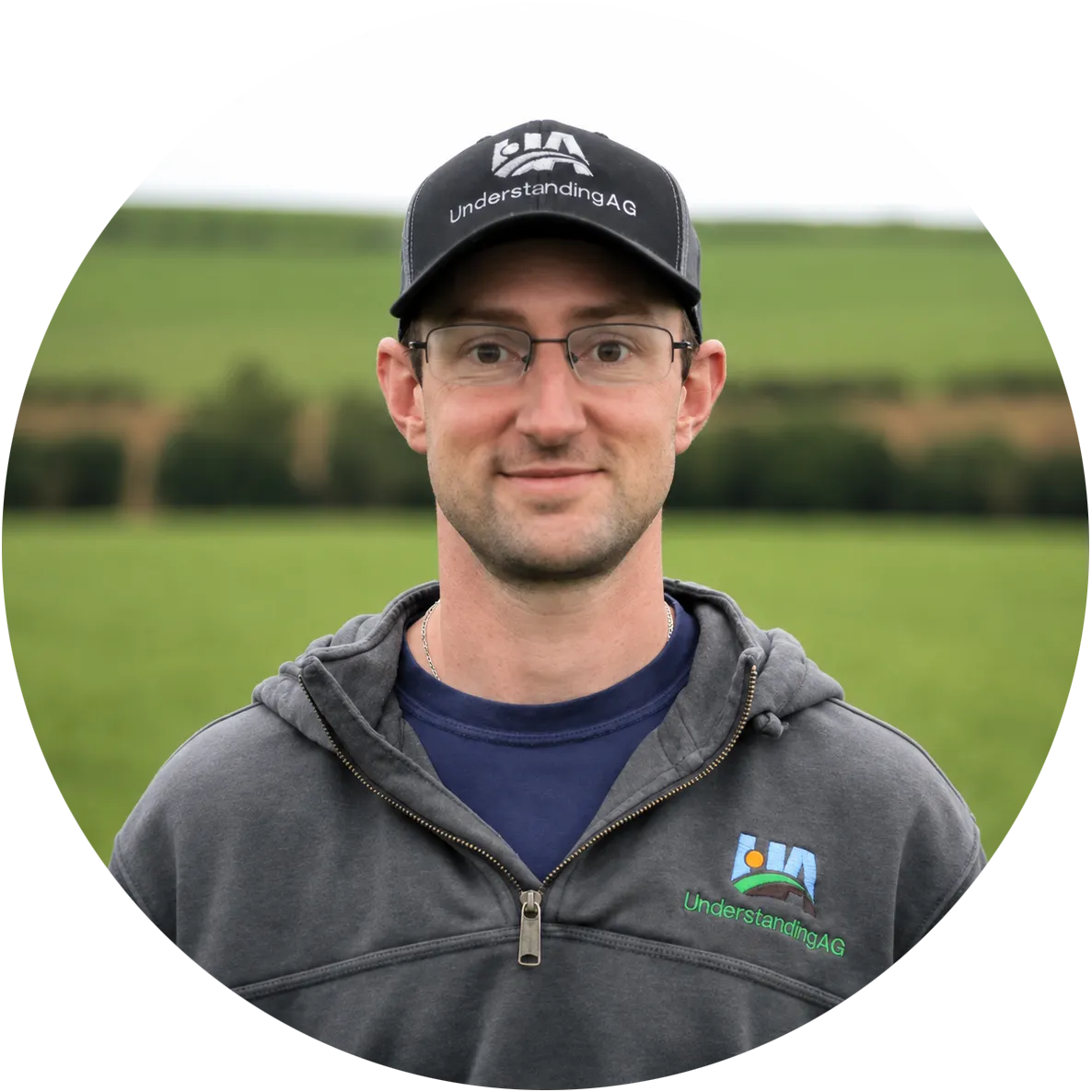
Kyle Richardville
Consultant with Understanding Ag
Kyle Richardville is a regenerative agriculture consultant with Understanding Ag whose background bridges nutrition, soil science and agricultural research. After studying nutrition and soil microbial ecology at Purdue University, he conducted research at Texas A&M and North Carolina A&T, focusing on soil biology and organic vegetable production. Most recently, Kyle spent three years in the United Kingdom helping farmers transition to regenerative agriculture alongside his wife, Michelle.
Decoding the Secrets of Soil: From Test Results to Better Decisions
A practical course that teaches farmers and agronomists how to interpret soil and plant tests and use them to make better management decisions.
Unlock the full course for just $47.
How Regenerative Food Reverses Chronic Disease

Brian Dougherty
Junior Partner - Understanding Ag
Brian Dougherty grew up on a family dairy farm in northeast Iowa, where he farmed for 17 years before pursuing advanced study in soil and agroecosystem function. He earned a B.S. in Ecological Engineering from Oregon State University and an M.S. in Agricultural and Biosystems Engineering from Iowa State University, focusing on soil health, nutrient management, and water quality.
A Nuffield Farming Scholar and former Iowa State Extension field agricultural engineer, Brian has worked with farmers across diverse systems to improve soil function and profitability. As a consultant with Understanding Ag, he helps producers better understand soil biology, chemistry, and physics to build resilient, regenerative operations.
Soil Tests Give You Numbers — But Not Always Answers
Farmers today have access to more soil and plant testing than ever before.
Conventional soil tests.
Haney tests.
PLFA and DNA tests.
Plant tissue and sap analysis.
But more data doesn’t always mean better decisions.
Too often, test results create confusion instead of clarity.
You’re left wondering:
What do these numbers actually mean?
Which tests are useful—and which are misleading?
How do soil and plant tests fit together?
What should I actually do differently in the field?
Without understanding how soil function works, test results can easily lead you in the wrong direction.
Learn to Interpret Soil Tests in the Context of Soil Function
Decoding the Secrets of Soil is a practical course designed to help you understand how soil and plant tests relate to real-world soil function.
Led by Brian Dougherty, regenerative agriculture consultant with Understanding Ag, this training brings together physical, chemical, biological, and plant testing into a clear framework for better decision-making.
Instead of chasing numbers, you’ll learn how to interpret tests within the bigger picture of:
Soil structure
Soil biology
Nutrient cycling
Plant health
Farm management
The goal is simple:
Turn test results into useful insight you can actually apply.
COURSE BREAKDOWN
Module 1: Soil & Plant Function
Understanding aggregation, soil structure, and how plants interact with the soil to acquire nutrients and water.
Module 2: Chemical Soil Tests
How to interpret conventional and total nutrient tests—and where they can be misleading.
Module 3: Physical & Biological Soil Tests
Understanding aggregation tests, Haney, PLFA, DNA analysis, and what they actually measure.
Module 4: Plant Testing
Using biomass, Brix, tissue testing, and sap analysis to understand plant nutrition and soil function.
Module 5: Putting It All Together
Real-world case studies showing how to interpret results and make practical management decisions.
Understanding Soil Biology
How living soil organisms help unlock nutrients bound in the mineral matrix and why biological nutrient release is a foundational strategy for resilient fertility.
Improving Nutrient Availability
Practical ways to leverage microbial activity to make existing nutrients more accessible to crops an approaches that can help reduce dependency on synthetic fertilizers.
Building Resilience and Profitability
Techniques that help maintain yields and crop health amid rising input costs and market uncertainty as well as strategies to strengthen plant performance.

About Acres U.S.A.®
Acres U.S.A.® is North America's oldest publisher (est. 1971) on production-scale organic and sustainable farming. For more than 50 years, our mission has been to help farmers, ranchers and market gardeners grow food profitably, sustainably, without harmful chemicals.

© Copyright 2026, Acres U.S.A.® Acres U.S.A.® is a registered trademark of Acres U.S.A.®, LLC. Reproduction of material in this issue in any form without permission of the publisher is prohibited. No permission required for photocopies made for personal use. Requests for permission to reprint must be in writing to PO Box 351, Viroqua, WI 54665; email [email protected].
© 2026 Acres U.S.A.® LLC - All Rights Reserved
Acres U.S.A. is North America’s oldest publisher on production-scale organic and regenerative farming. For more than 50 years, our mission has been to help farmers, ranchers and market gardeners grow food profitably, regeneratively, and with nature in mind.
support@acresusa.com
970-392-4464